
Picture this: You’re sitting in Charles de Gaulle Airport, scrolling through your phone, watching your departure time change for the third time in two hours. Your Instagram stories show frustrated travelers camping out with their luggage, flight boards displaying an endless sea of red “CANCELLED” notifications, and airport staff apologizing over crackling intercoms. Welcome to the reality of France travel chaos in September 2025.
The air traffic control strike that was supposed to cripple French airspace on September 18th got postponed at the last minute. But don’t breathe that sigh of relief just yet.
Europe is still drowning in one of the worst travel disruptions we’ve seen all year. While French controllers stepped back from the brink, the rest of Europe doubled down on industrial action that’s turning dream vacations into expensive nightmares.
What started as isolated labor disputes across different countries has snowballed into a continental crisis. Spain, Portugal, Italy, and the Netherlands are all dealing with simultaneous strikes.
The timing couldn’t be worse for American travelers who thought they’d dodge the summer rush by planning September getaways.
The Last-Minute Strike Delay That Saved France Travel Chaos From Getting Worse
French air traffic controllers made a surprising decision on September 17th. They postponed their planned strike after emergency negotiations with government officials.
The unions cited “productive dialogue” as their reason for backing down. Translation: they got enough promises to pause their action.
This delay prevented what could have been the worst day for European air travel in 2025. France handles more than 3 million flights per year. A complete shutdown would have created ripple effects across the entire continent.
Every flight to or from France would have faced cancellation. Even flights passing through French airspace would have needed rerouting.
But here’s the catch. The strike is only delayed, not cancelled. Union leaders made it clear this is a temporary pause.
They’re giving the government time to deliver on promised improvements to working conditions and pay. If those promises don’t materialize, the strikes will resume with even more intensity.
The delay also exposed how fragile Europe’s air traffic system really is. One country threatening to strike sent airlines scrambling to cancel thousands of flights preemptively. It showed just how interconnected European airspace has become.
Why Europe Can’t Escape Travel Disruption Despite France Travel Chaos Postponement
The French delay should have been good news. Instead, it barely made a dent in the chaos engulfing European travel.
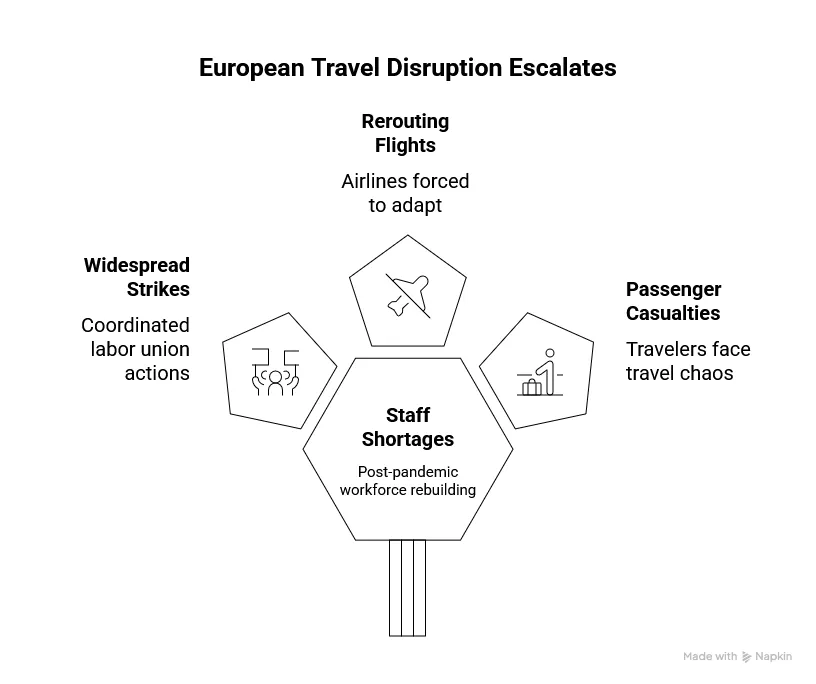
Other countries filled the void left by France’s postponed strike. Spain‘s ground crew walked off the job. Italian air traffic controllers followed suit. Dutch airport workers joined the movement.
Each country has its own grievances, but the underlying issues are strikingly similar. Post-pandemic staffing shortages have pushed workers to their breaking point.
Airlines cut thousands of jobs during COVID-19. Now they’re struggling to rebuild their workforce while handling record passenger volumes.
Workers are demanding better pay, improved working conditions, and more reasonable schedules. Management teams are caught between union demands and pressure to keep costs low in a competitive market. The result is a standoff that’s turning passengers into casualties.
The strikes aren’t random acts of defiance. They’re coordinated efforts timed for maximum impact. Labor unions across Europe are sharing strategies and timing their actions to amplify disruption.
When one country strikes, it forces airlines to reroute through other countries, putting additional strain on those systems.
The Real Cost of European Travel Strikes on American Tourists
American travelers are bearing the brunt of these labor disputes. September is peak shoulder season for European travel.
It’s when Americans try to avoid summer crowds while still enjoying decent weather. This year, they’re finding themselves trapped in a continental labor war.
The financial impact goes far beyond cancelled flights. Hotels in major cities are packed with stranded passengers. Prices for available rooms have skyrocketed overnight.
A standard hotel room in Amsterdam that normally costs $150 is now going for $400. Many hotels are completely sold out.
Car rentals have become impossible to find. Rental agencies are running out of vehicles as passengers scramble for alternative transportation.
Train systems are overwhelmed with people trying to reach their destinations by rail. High-speed train tickets that used to be available same-day now have waiting lists.
Food courts in major airports are running out of supplies. Restaurants can’t keep up with the influx of stranded passengers. Vending machines are empty. Airport lounges are at capacity. The entire infrastructure is buckling under unexpected demand.
Travel insurance companies are being flooded with claims. But many policies don’t cover strikes unless they’re declared “unforeseen” at the time of booking.
Since labor unrest has been brewing for months, insurance companies are denying many claims. Passengers are stuck with bills they never expected.
How France Travel Chaos Reveals Deeper Problems in European Aviation
The strikes are exposing systemic problems that go far beyond temporary labor disputes. European aviation infrastructure is operating at capacity limits. There’s no buffer for disruption. When one component fails, the entire system groans under pressure.
Air traffic control systems across Europe are using outdated technology. Many controllers are working with equipment installed in the 1990s.
Modernization efforts have been slow and underfunded. Controllers are managing more flights with fewer resources than ever before.
Airport infrastructure hasn’t kept pace with passenger growth. Terminals designed for 20 million annual passengers are handling 35 million.
Security checkpoints, baggage systems, and gate areas are all overwhelmed. The strikes are happening against this backdrop of strained infrastructure.
Airline staffing models are fundamentally broken. Carriers optimized their operations for efficiency during stable times.
They don’t have redundancy built in for disruption. When strikes happen, there are no backup crews or spare aircraft to maintain operations.
The hub-and-spoke model that makes European travel efficient also makes it fragile. When major hubs like Amsterdam, Paris, or Frankfurt face disruption, it cascades through the entire network.
Passengers trying to fly from Barcelona to Rome might face cancellation because their connection goes through a striking airport.
Smart Survival Strategies for Navigating Current European Travel Disruption
Travelers currently in Europe or planning trips need practical strategies for dealing with ongoing chaos. The first rule is flexibility. Your original itinerary is probably not going to work. Accept that reality early and start making backup plans.
Download every airline app on your phone. Don’t just rely on your carrier. Other airlines might have last-minute availability when your flight gets cancelled.
European airlines are required to rebook you on competitors if they can’t get you there within reasonable time.
Book refundable hotel rooms at multiple properties. Make reservations at hotels near airports, train stations, and your original destination.
Cancel the ones you don’t need. It’s better to lose a small booking fee than to pay surge pricing when you’re stranded.
Keep cash on hand. Credit card systems can get overwhelmed during major disruptions. Airport WiFi might be slow.
Cash works when technology fails. Have enough euros to cover meals, transportation, and emergency accommodation.
Pack essential items in your carry-on. Assume your checked bag might not make it to your destination on time.
Bring medications, change of clothes, and anything you absolutely need for your trip. Checked baggage is often the first casualty of operational chaos.
Know your passenger rights. European Union regulations are actually quite strong. You’re entitled to meals, accommodation, and compensation for significant delays. Airlines don’t advertise these rights, but they’re legally required to provide them.
What Airlines Aren’t Telling Passengers About Strike Compensation
European passenger rights laws are more generous than most Americans realize. Under EU Regulation 261, you have significant protections during flight disruptions. Airlines are required to provide care and compensation, even during strikes.
If your flight is cancelled, you get three options. You can get a full refund, rebooking on the next available flight, or rebooking on a date that works for you. The airline has to offer all three options. They can’t just offer a voucher and call it even.
For delays over two hours, airlines must provide meals and refreshments. For overnight delays, they must provide hotel accommodation and transportation to the hotel. This applies even when the delay is caused by strikes.
Compensation payments depend on distance and delay length. Flights under 1,500 kilometers delayed more than three hours earn €250 per passenger. Longer flights can earn up to €600 per passenger. These payments are in addition to refunds or rebooking.
Airlines often claim strikes are “extraordinary circumstances” that exempt them from compensation. This isn’t always true. Courts have ruled that compensation is still required when airlines had advance notice of strikes and could have taken preventive measures.
Document everything. Take photos of delay boards, save receipts for meals and accommodation, and keep records of any expenses caused by the disruption. You’ll need this evidence when filing compensation claims later.
The Ripple Effects Beyond Cancelled Flights and Missed Connections
The travel chaos is creating problems that extend far beyond aviation. European tourism businesses are scrambling to deal with the fallout. Hotels in popular destinations are seeing mass cancellations as visitors can’t reach them.
Restaurants, tour companies, and attractions are losing revenue from no-show customers. Many American tourists book complete vacation packages that include multiple components. When flights get cancelled, everything else falls apart too.
European cities that depend on tourism revenue are watching their peak season profits evaporate. Amsterdam, Rome, and Barcelona normally see their busiest weeks in September. Instead, they’re dealing with empty hotel rooms and frustrated business owners.
The strikes are also affecting business travel. Conferences are being cancelled or postponed. International meetings are moving to video calls. Companies are losing productivity and revenue from disrupted business trips.
Cargo flights are facing the same disruptions as passenger flights. European supply chains are experiencing delays. Fresh produce, manufactured goods, and time-sensitive shipments are all affected by the aviation chaos.
Looking Ahead: When Will France Travel Chaos and European Strikes End
Predicting the end of European travel strikes is like forecasting the weather six months out. Too many variables are at play. Union negotiations are happening in multiple countries simultaneously. Progress in one country doesn’t guarantee resolution in another.
French air traffic controllers postponed their strike, but they didn’t abandon it. Government officials have until early October to deliver on their promises. If workers don’t see meaningful changes by then, the strikes will resume with added intensity.
Other European countries are at different stages of their labor disputes. Some unions are just beginning their campaigns. Others have been striking for weeks. The lack of coordination makes it impossible to predict a clear end date.
Economic pressure might eventually force resolutions. Airlines are losing millions of euros every day. Governments are seeing tourism revenue disappear. Hotels, restaurants, and other businesses are demanding action. This financial pain could accelerate negotiations.
Winter typically brings fewer strikes in the aviation industry. Demand drops, giving airlines more flexibility to deal with disruption. But that’s still months away. The peak travel season runs through October in most European destinations.
The smart money is betting on gradual resolution rather than sudden improvement. Individual countries will likely resolve their disputes at different times. Europe will slowly return to normal operations, but it might take until early 2026 for full stability.
Your Action Plan for European Travel in the Next Six Months
European travel won’t return to normal overnight. Smart travelers are already adapting their strategies for the next several months. The days of booking a flight and assuming it will operate on time are temporarily over.
Build extra time into your European travel plans. What used to be a quick weekend trip might need to become a longer vacation. Factor in potential delays when planning connections and important events.
Consider alternative destinations. While Western Europe deals with strikes, Eastern European countries remain relatively stable. Poland, Czech Republic, and Hungary offer great cultural experiences with less travel chaos.
Book travel insurance that specifically covers strike disruptions. Read the fine print carefully. Some policies exclude strikes that were known at the time of booking. Others provide broader coverage for any type of disruption.
Stay flexible with your travel dates. Avoid booking non-refundable accommodations or activities until your flights are confirmed. The ability to adjust your plans quickly will be crucial in the coming months.
Monitor strike announcements religiously. European unions typically announce strikes several days in advance. Set up news alerts for your departure and arrival cities. Knowledge gives you time to make alternative arrangements.
The current France travel chaos and broader European strike situation will eventually end. But the disruption has exposed fundamental weaknesses in Europe’s travel infrastructure.
These problems won’t disappear with the strikes. Airlines, airports, and governments need to invest in more resilient systems.
For now, European travel requires patience, flexibility, and careful planning. The continent’s amazing destinations are still worth visiting.
You just need to be prepared for a more complicated journey to reach them. The travelers who adapt to this new reality will still have great European adventures. Those who don’t might find themselves starring in their own travel chaos stories.
Sources
Source: European Union Official Legal Database (EUR-Lex)
URL: https://europa.eu/youreurope/citizens/travel/passenger-rights/air/index_en.htm
Source: International Air Transport Association
URL: https://www.iata.org/en/services/data/market-data/world-air-transport-statistics/