
The early signs of trouble are already showing at America’s busiest airports. As the US GOVERNMENT SHUTDOWN takes hold, passengers are bracing for long lines, frustrated staff, and delayed flights.
For many travelers, the chaos at TSA checkpoints is not just an inconvenience—it’s a glimpse of how government gridlock spills into daily life. Families, business travelers, and tourists alike are beginning to feel the pinch.
The scene is tense. Travelers shuffle through crowded terminals, glancing nervously at the clock. Parents struggle to keep children entertained while standing in seemingly endless security lines.
Airline staff make rushed announcements over loudspeakers, trying to manage growing crowds. The atmosphere feels more like a crisis zone than a travel hub. This is the real-world impact of a political standoff in Washington.
The Ripple Effects of a Shutdown on Travel
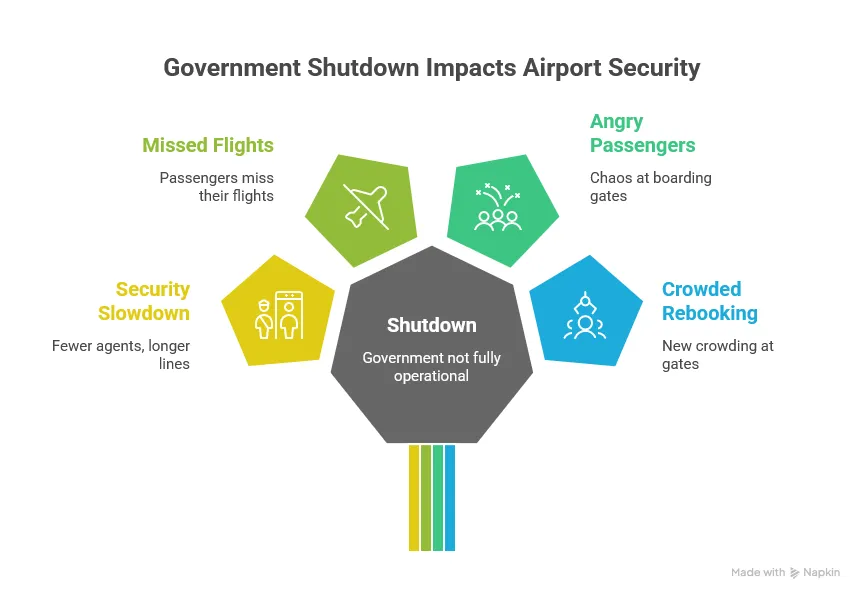
Airports are fragile systems. When one part breaks down, the effects spread quickly. Security checkpoints are the gateway to every flight, and when they slow, everything else stalls. Missed flights lead to angry passengers.
Angry passengers create chaos at boarding gates. Rebooked flights create new crowding. It’s a chain reaction that spirals out of control.
The US GOVERNMENT SHUTDOWN is making this cycle worse with each passing day. Many TSA officers are federal employees required to work without pay.
Some show up, tired and stressed. Others cannot afford the commute and stay home. With fewer agents on duty, every line stretches longer. For travelers, it feels like a system on the edge of collapse.
TSA Workers Are the Human Face of the Shutdown
Behind the uniforms are real people with real struggles. Many TSA workers live paycheck to paycheck. Without steady income, bills pile up and daily life becomes harder. Yet many still put on their uniforms and step into the airport, working under enormous stress.
Some agents say they can no longer afford gas or childcare. Others pick up temporary jobs after their shifts just to keep food on the table.
Morale is crumbling. Passengers often see the frustration on the faces of workers as they attempt to keep order in a chaotic environment.
The US GOVERNMENT SHUTDOWN has turned these everyday workers into unwilling symbols of a political battle far beyond their control. For many, it feels like being trapped between loyalty to their job and responsibility to their families.
Why Airports Feel the Impact First
Airports are high-pressure environments on normal days. Security relies on precision and timing. A small disruption can cause big problems. When TSA staffing drops because of the shutdown, the balance falls apart.
Travelers who usually breeze through checkpoints with PreCheck or clearances now face delays. Airlines struggle to keep boarding on schedule.
Connections are missed, creating ripple effects across the entire flight network. For passengers on tight schedules, the stress is overwhelming.
Every extra minute spent in line is a reminder of how much the US GOVERNMENT SHUTDOWN affects ordinary lives.
It’s not just about politics—it’s about the family visiting relatives, the student traveling for studies, or the businessperson trying to make an important meeting.
US GOVERNMENT SHUTDOWN and the Passenger Experience
The shutdown is not a distant event happening in the halls of Congress. It is lived out in terminals across the country. Travelers describe the atmosphere as tense, with tempers running high. Some try to arrive hours earlier, only to find themselves still barely making flights.
For families traveling with children, the stress is even greater. Long waits drain patience, and simple things like finding a seat at a crowded gate become battles.
International travelers, unfamiliar with U.S. shutdown politics, look confused and frustrated as they try to understand why a superpower nation cannot keep its airports running smoothly.
Airlines Under Pressure
Airlines depend on efficiency. The faster passengers move through security, the smoother schedules run. When that breaks down, airlines face logistical nightmares. Crews get stuck in traffic or delayed lines. Flight connections break. Entire schedules shift, often at great cost.
Airlines are now issuing travel advisories, warning passengers to expect delays. Some are adjusting boarding times to account for the extra wait. But no amount of planning can fully prepare for the unpredictable pace of TSA checkpoints during a shutdown.
For airline staff, every day becomes a balancing act between managing passengers and keeping flights on schedule.
The Hidden Costs of the Shutdown
Beyond delays and stress, the shutdown carries hidden costs. Travelers lose valuable time. Businesses face disrupted schedules. Tourism takes a hit as international visitors rethink trips to the U.S. A country known for efficiency suddenly looks fragile.
The cost is not just financial—it’s emotional. Families miss reunions. Students miss exams. Patients miss medical appointments. These moments cannot be rescheduled.
The US GOVERNMENT SHUTDOWN is not just a political fight; it’s a disruption to the human rhythm of everyday life.
Stories from the Lines
ravelers have shared countless stories from airports during shutdowns. A mother in Atlanta described waiting three hours in line with her toddler, only to miss her flight.
A businessman in Chicago said he had to cancel a major meeting after being stranded overnight. In Los Angeles, TSA lines stretched so far that police officers were called in to manage the crowd.
For each story, thousands more go untold. The frustration is shared by millions, and every experience reinforces the sense of uncertainty. Passengers no longer trust that their flights will go smoothly. Instead, they brace for problems before they even reach the airport.
The Bigger Picture: Beyond the TSA
While the TSA chaos draws headlines, the shutdown affects many other federal services. Air traffic controllers face similar pressures, working long hours without pay. Federal safety inspectors are stretched thin, raising questions about oversight. National parks, passport services, and public health agencies also feel the strain.
But few places show the impact as clearly as airports. Air travel is immediate, visible, and deeply personal. Every canceled flight and every delayed passenger becomes a reminder of what’s at stake when government functions stop.
Can Travelers Do Anything?
Travelers cannot control the shutdown, but they can prepare. Arriving earlier than usual, packing with security in mind, and checking airline updates are small steps that help reduce stress.
Some travelers reschedule flights to less busy times of day. Others avoid air travel altogether until stability returns.
While these adjustments may help, they do not fix the underlying issue. No amount of planning can replace a fully staffed and functioning TSA. Until the shutdown ends, every traveler must carry extra patience along with their luggage.
What’s Next for TSA and Passengers?
If the shutdown drags on, the situation could worsen. More TSA workers may quit. Wait times could double. Airlines may cut flights to manage schedules. Travelers might see entire sections of terminals closed due to staffing shortages.
The uncertainty is the hardest part. No one knows how long the shutdown will last. For passengers planning trips weeks in advance, the risk of disruption feels like a looming shadow. For TSA workers, every day is another test of resilience.
Conclusion
The US GOVERNMENT SHUTDOWN is more than a headline—it is a crisis playing out in real time at airports across the country. TSA workers face impossible choices, airlines battle delays, and passengers live with the daily stress of uncertainty.
What begins as a political fight in Washington ends up in the crowded terminals of New York, Atlanta, Chicago, and Los Angeles.
For travelers, patience and preparation are the only tools left. For workers, endurance is the only option. And for the nation, the shutdown is a stark reminder of how fragile everyday systems really are.
Until leaders in Washington find common ground, airports will remain a symbol of the chaos and cost of a government on pause.